


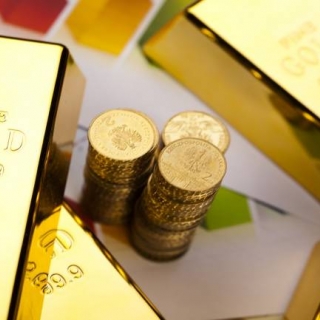
Gold fell as optimism that the Federal Reserve will cut interest rates next month was shaken by continued uncertainty over economic data, following the longest government shutdown in U.S. history.
Expectations for a Fed rate cut declined as the week progressed, with Fed officials showing little confidence in reducing borrowing costs. Higher interest rates typically make non-yielding bullion relatively less attractive to investors.
Traders are now divided on the likelihood of a December rate cut, having previously expected a quarter-point cut less than a month ago. Attention now turns to comments from three Fed officials due to speak on Friday, including voting member Jeffrey Schmid.
Several Fed officials "have signaled that they would be uncomfortable with further rate cuts without reliable data on the labor market and inflation," wrote Thu Lan Nguyen, head of currency and commodity research at Commerzbank AG, in a note on Friday. "Therefore, there is a risk that the majority will decide against raising interest rates in December for the time being, until the picture becomes clearer."
Gold's recent high correlation to riskier assets suggests that the unwinding of the currency depreciation trade is starting to take place later in the year, according to TD Securities. "Government bonds outperform gold as a safe-haven asset during this period of risk aversion," said Dan Ghali, senior commodity strategist, in a note.
The precious metal experienced increased volatility this week, which may have been exacerbated by a so-called "gamma squeeze," a technical pattern in which traders selling low-priced options are forced to buy gold futures as a hedge. In a thin market, a sudden price increase can increase the urgency to buy and escalate into a surge even without new demand from physical buyers.
Ghali said this week's gold rebound aligns with this dynamic. He noted that the recent decline in over-the-counter trading volumes has made the market more susceptible to influence. "This liquidity vacuum may actually be the key to creating a gamma squeeze, which resulted in a second, higher shock wave this week," he said.
Gold bullion is still up about 55% this year and remains on target for its best annual performance since 1979. Central banks have stepped up purchases, seeking a store of value and asset diversification, while investors have piled into the metal as a hedge against growing fiscal unease in some of the world's largest economies.
Gold fell 2.2% to $4,078.14 an ounce as of 10:34 a.m. in New York. The Bloomberg Dollar Spot Index was little changed. Silver fell 2.4% to $51.06 an ounce, while platinum and palladium also fell. (alg)
Source: Bloomberg
Gold prices weakened slightly on Thursday (February 12th), as more solid US employment data reduced market confidence in an imminent Federal Reserve interest rate cut. The strong employment data promp...
Gold prices strengthened on Wednesday, supported by a weaker US dollar and falling US bond yields after the latest economic data reinforced the narrative that the Federal Reserve is likely to continue...
Gold experienced a slight correction in the European session on Tuesday (February 10th), but remained above $5,000/oz as the market held its breath ahead of a series of US data that could alter intere...
Gold held above the psychological $5,000 level at the start of the week, supported by a combination of factors that are "right" for the precious metal : physical demand from China, expectations of low...
Gold prices are still struggling to turn an intraday rebound into a sustained rally. After briefly falling to $4,654 (a four day low) and rebounding, prices were again rejected near $4,900. In the Eur...
Oil prices stabilized on Thursday (February 12th), as the market reassigned a risk premium to US-Iran tensions despite US inventory data showing swelling domestic supplies. This movement confirms one thing: geopolitical headlines are still more...
Gold prices weakened slightly on Thursday (February 12th), as more solid US employment data reduced market confidence in an imminent Federal Reserve interest rate cut. The strong employment data prompted market participants to shift expectations of...
The Hang Seng Index reversed its downward trend in Hong Kong on Thursday (February 12th), weakening by around 0.9% to around 27,000 after a strong session earlier. This decline halted the momentum of the short term rally, as investors began to...